This was supposed to be a daily practice but it's not at all.
Luckily, a few things are happening and my schedule is a little packed sometimes.
And this one will not exactly be a news, but it's something that caught my attention anyway.
I was in Milan for START last week and had the chance to see a really interesting place called Brown Project Space, which is born from an online magazine that later became a physical space. The Project Space will not only be the office to work on the magazine, but will host an exhibition program, revealing itself as a new way to think about curatorial practices today.
Artists-run-spaces are not that popular in Italy, and this is why I feel the choice of artists Luigi Presicce and Luca Francesconi was so interesting.
They probably have to face lots of troubles that other similar places in europe do not have to, but anyway they are doing a really good job.
The place itself is really interesting, as it is an underground, almost hidden couple of rooms.
The space opened with a double-solo-show from artists Jacopo Miliani (ita, 1979) and Richard Clements (uk, 1983) and the two exhibition work so well together as they play on echoes of shapes and colors.
They both play very well with the space, creating a sort of stage and playing with the interaction with the spectator (Miliani) and reflecting on shape, colors and materials (Clements).
Brown represents a breath of fresh air to the local and national scene and I can't wait to see what's next.
lunedì 29 settembre 2008

martedì 16 settembre 2008
70.545.100
This is the amount of £ that were payed yesterday for the first day of auctions at Sotheby's for Damien Hirtst's pieces. Some of them were sold for three times the expected prices of the quotations. And this is already considered a historic event, even more if you think that there's still many pieces that are going to be sold tonight.
Not bad if you consider that even TG5 (italian people know what I am talking about) was talking about it today :)
Not bad if you consider that even TG5 (italian people know what I am talking about) was talking about it today :)
giovedì 11 settembre 2008
blurring edges
 I already told how much I love art in which there's no clear definition between one technique and the other. I was doing a research yesterday and got to see some amazing pictures of Jenny Holzer's installation at Neue Nationalgalerie in 2001.
One could say it's a visual art installation but I really cannot help thinking it as architecture. And I find amazing how the lights reflect on the glass of the windows and look like as if they were continuing in the sky. This is just perfection and it's so hard to decide WHICH kind of art it is.
lunedì 8 settembre 2008
More Notes on Manifesta7 - favourite works
One of the best works shown in the exhibition was Omer Fast's piece Looking pretty for God. His video is a sort of documentary about small funeral houses held by families from several generations in the US as a business which is fast disappearing.
The definition of boundaries in Fast's work is definetly useless: his video are not exactly documentaries but not exactly fictional either.
The borders in his works finish to melt and blur as it's really hard to give a definition of them.
Different points of view and voices join and confuse themselves in this work, which talks about death without showing it, and instead chooses images of childhood, make-up and emptiness.
This creates a much stronger effect even though it's not showing anything about death, working on a sense of anxiety which is very subtle and slight.
There's a cultural gap in the way we see death, and this underlined so many aspects we do not consider in our society about dead bodies.
The video reflects on the difficult passage from the painful private dimension of death to the public one, which has to look more pretty and -possibly- healthy.
It's really moving, in some points, to see how normal this job is for people who do it, and how hard it is for the one who have to relate to them.
The choice of using children with lipsync from the interviews is incredibly delicate and lyrical.
giovedì 4 settembre 2008
Notes on Manifesta7 - favourite works
I have to say there's some works that are worth a whole exhibition.
There are so many good pieces shown @Manifesta7 it would be stupid to try to talk about all of them. But there's a few that cannot really be missed
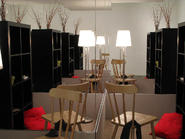
The first one I want to talk about is Beth Campbell's "Following room".
I already saw this piece last winter @Whitney museum, but as I read her name on the wall and turned the corner to enter the room I was amazed as the first time I saw it.
There's something so perfect and fascinating about this piece that makes me feel moved everytime I see it. There's this slightly maniac attitude in it and in its realization that makes me think THIS is the kind of art that can really be considered a high quality work, for its realization and its inner meanings.
There's so much about chances and possibilities in this work (as in the whole production of Campbell's works) and it leaves so much up to you. This is what I think art should do.
I also had the chance to meet her in her studio in Brooklin and after that I appreciated her work even more if possible, considering how incredible she is even as a person.
domenica 24 agosto 2008
notes on Manifesta7 - the approach to the public
 Last week I went to Manifesta7 (again!) as I wanted to see some of the works better than how I did during the opening days. I have to admit it was much better this way (no more than...let's say 7 visitors in each one of the venues?!)
I have enough topics about it to fill this blog for weeks so I guess it's better to write different posts.
What I noticed immediately is that the different curatorial approaches were so evident in the different venues.
Rovereto was almost didactic: each work had a short text and info about the artist. The visitors had a lot to read before they started looking at the works.
Trento was completely opposite (I guess how does a "normal" visitor react to something like this - someone told me they felt completely lost).
Bolzano had the same short text (this time in 3 languages: don't forget the German translation please!) while Fortezza was something I really couldn't explain. The infos on the works were so hard to find that at some point I gave up and just wandered around.
It's not so important to discuss from my point of view, but I would really like to think about a visitor that does not know anything about contemporary art. Some of the venues really tried to reach the public while other were rejecting it completely, and this is something I don't really feel as a right position. I don't want to sound obvious, but as long as we will have exhibitions like this everyone in Italy will say they don't understand contemporary art and that contemporary sucks. (You should have read the comments of people outside the venues after 1 month of exhibition!!!)
One more thing I would like to say is about the ordinary maintenance of the exhibition: after one month the exhibition looked already like it was 3 months old.
The works in Rovereto railway station were mostly damaged. Seems like no one is looking after them, I guess they expected this when they decided to show part of them in a place which is so crowded (and where people didn't choose to see art) but I think most of the damages could be avoided. It's almost the same for Trento: the day I visited it a lot of works were closed because I guess the people that were working there didn't know how to use it: when they changed their working turns, the new staff put everything back to normality.
It's such a huge event, I guess this should not happen. Uhm.
(But I still have lots to say about it, also a lot of good things! So I will be back soon)
venerdì 15 agosto 2008
about Damien and money

Seems like everytime you read something new about Damien Hirst some part of the article HAS to talk about money. And so it's also this time: I was reading about his next auction at Sotheby's in september.
He will sell something like 220 works for a total expected amount of about 65.000.000 £ (without any mediation from his galleries - which I bet are pretty happy about it)
And what it's even more interesting is the title of the auction session: "The Beauty Inside My Head Forever". Uhm. I am wondering what's the use of such a poetic and tragic title for something like this.
I prefer to look at The Little Artists and their funny reproductions of Hirst's works. At least there's still something ironic in it.
Iscriviti a:
Post (Atom)